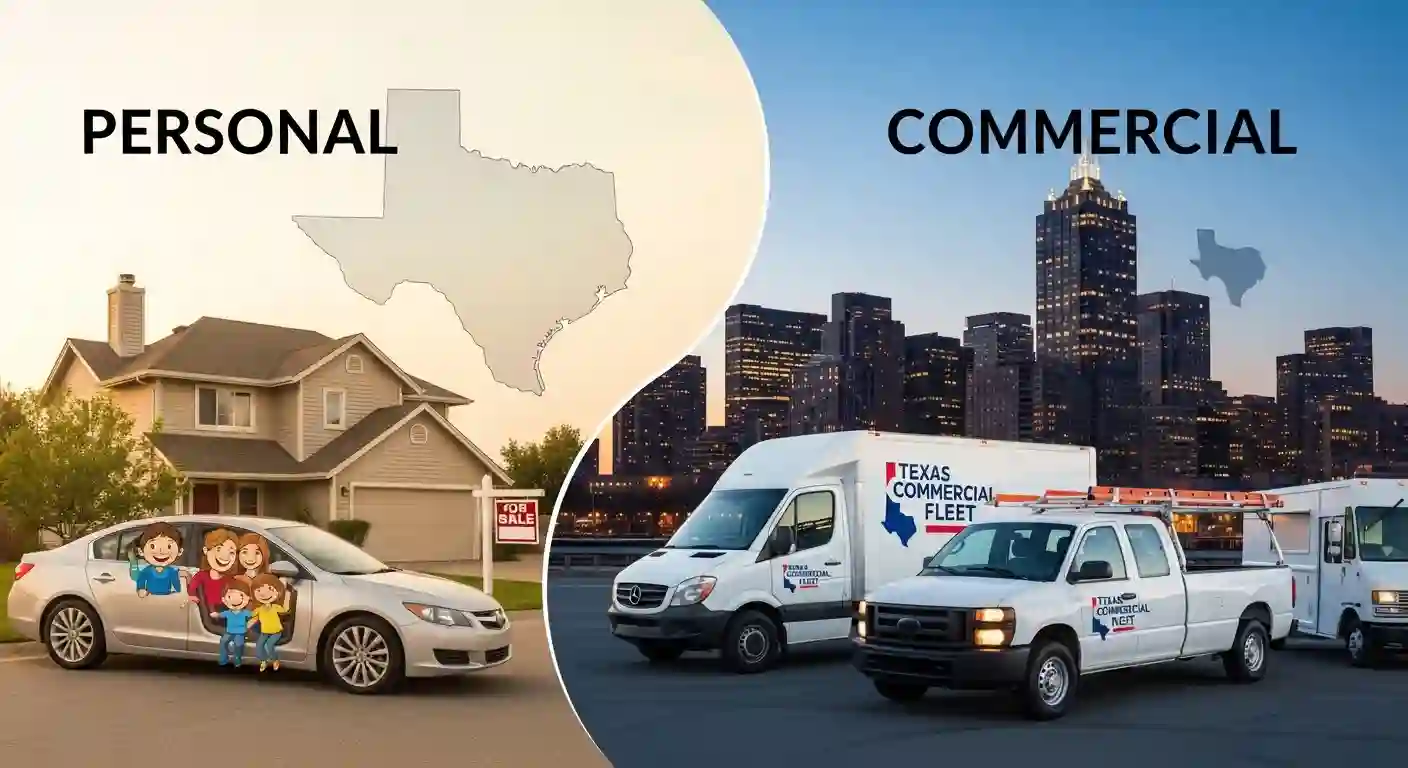
Using your personal vehicle for business purposes in Texas could leave you completely uninsured when you need coverage most. Many Texas drivers don’t realize their personal auto insurance won’t cover accidents that happen during business use, even if they’re just delivering food or meeting clients.
The distinction between personal and commercial auto insurance matters more than ever in 2026. With the rise of gig economy jobs, remote work requiring client visits, and side businesses, understanding which coverage you need protects you from devastating financial losses and legal problems.
This guide explains the critical differences between personal and commercial auto insurance in Texas, when each type applies, and how to choose the right coverage for your situation without overpaying.
What Is Personal Auto Insurance in Texas?
Personal auto insurance covers vehicles you use for everyday activities like commuting to work, running errands, and personal travel. Texas law requires all drivers to carry minimum liability coverage, but personal policies have strict limits on business use.
Texas Minimum Insurance Requirements
Texas requires personal auto insurance with these minimum liability limits:
- $30,000 bodily injury per person
- $60,000 bodily injury per accident
- $25,000 property damage per accident
These limits represent the minimum required for most personal vehicles in Texas. Businesses often carry significantly higher limits because commercial operations create greater liability exposure.
What Personal Auto Insurance Covers
Standard personal auto policies provide several types of coverage:
- Liability coverage (damages you cause to others)
- Collision coverage (damage to your vehicle from accidents)
- Comprehensive coverage (theft, vandalism, weather, animals)
- Uninsured/underinsured motorist coverage
- Medical payments
- Personal Injury Protection
- Rental car reimbursement
- Roadside assistance
Permitted Uses Under Personal Auto Insurance
Personal auto insurance covers these typical activities:
- Commuting to and from your regular workplace
- Personal errands and shopping trips
- Social and recreational driving
- Vacation and personal travel
- Visiting family and friends
The critical limitation: Personal auto policies often exclude or restrict coverage for many business activities, especially deliveries, transporting goods, or commercial services. This creates dangerous gaps if you use your car for work without proper commercial insurance.
Average Personal Auto Insurance Cost in Texas
Auto insurance costs depend on the driver, vehicle, location, and coverage limits. Many drivers may pay approximately:
- State average: $1,000-$2,200 annually
- Houston: $2,000-$2,800 annually
- Dallas-Fort Worth: $1,900-$2,600 annually
- Austin area: $1,600-$2,300 annually
- San Antonio: $1,500-$2,100 annually
Rates vary based on driving history, age, vehicle type, coverage limits, and location. Urban areas cost more due to higher accident rates and vehicle theft.
Review your auto insurance policy to understand exactly what business activities are covered before using your vehicle for work.
What Is Commercial Auto Insurance?
Commercial auto insurance covers vehicles used primarily for business purposes. It provides broader protection than personal policies and includes coverage for business-related activities that personal insurance excludes.
What Commercial Auto Insurance Covers
Commercial policies provide comprehensive business-use protection:
- Liability for accidents during business activities
- Physical damage to business vehicles
- Medical payments for injuries to drivers and passengers
- Uninsured/underinsured motorist protection
- Cargo and equipment coverage (for transported goods)
- Towing and labor coverage
- Rental reimbursement for business vehicles
- Coverage for employees driving on company business
- Coverage for third-party bodily injury and property damage caused by an employee while driving for business.
Who Needs Commercial Auto Insurance
Commercial auto insurance is essential for:
- Vehicles registered under a business name
- Companies with fleet vehicles
- Delivery and courier services
- Contractors and tradespeople
- Food Trucks
- Sales representatives visiting clients
- Real estate agents showing properties
- Businesses transporting goods or materials
- Any business using vehicles for revenue-generating activities
Commercial Auto Insurance Cost in Texas
Commercial policies cost more than personal insurance due to increased business liability exposure:
- Single vehicle (liability only) = $1,000-$2,500+ annually
- Single vehicle (full coverage) = $2,500-$5,000+ annually
- Small fleet (2 to 10 vehicles) = $1,200 – $8,000+ annually estimated
- Delivery vehicles = $3,000-$6,000+ per vehicle annually
- Commercial trucks = $5,000-$12,000+ per vehicle annually (depends on truck type)
Costs depend on vehicle type, business use, driver records, coverage limits, and cargo value. Higher liability limits significantly increase premiums but provide crucial protection.
Key Differences Between Personal and Commercial Auto Insurance
Understanding these critical differences helps you choose appropriate coverage and avoid dangerous gaps in protection.
Coverage Scope and Purpose
Personal auto insurance: Designed for personal use needs. Covers commuting, errands, and recreational driving. Excludes most business activities.
Commercial auto insurance: Specifically covers business use. Protects revenue-generating activities, employee drivers, and business liability. No restrictions on commercial activities.
Liability Limits and Exposure
Personal policies: In Texas, minimum liability limits start at $30,000 per person/ $60,000 per accident for bodily injury, and $25,000 for property damage.
Commercial policies: While Texas minimum liability limits are $30,000/$60,000/$25,000, most commercial auto policies carry much higher limits, commonly $500,000 or $1,000,000, due to increased business liability risks.
Who’s Covered to Drive
Personal coverage: Covers named drivers on the policy and sometimes household members. Limited coverage for occasional drivers.
Commercial coverage: Covers any employee operating the vehicle for business purposes. Broader driver coverage is essential for business operations.
Claims Process and Documentation
Personal claims: Simpler process with standard documentation. Insurers also investigate to verify the accident wasn’t business-related.
Commercial claims: More complex, with additional business documentation required. May need business records, trip logs, and employee information.
When Do You Need Commercial Auto Insurance in Texas?

Determining when you need commercial coverage isn’t always straightforward. These scenarios require commercial auto insurance in Texas.
Specific Industries and Professions
These professions typically require commercial auto insurance in Texas:
- Contractors and construction workers
- Landscapers and lawn care services
- Plumbers, electricians, and HVAC technicians
- Real estate agents and property managers
- Sales representatives with regular client visits
- Catering and food service businesses
- Home healthcare and medical services
- Pet groomers and mobile services
- Cleaning and maintenance services
- Any business using vehicles for revenue-generating activities
Employee Drivers
If employees drive for your business, you need commercial coverage:
- Employees driving company vehicles
- Employees using personal vehicles for business errands
- Multiple drivers operating business vehicles
- Employees transporting goods or clients
Hired and non-owned auto coverage protects your business when employees use their own vehicles for work. This prevents gaps in coverage that could bankrupt your business after an accident.
Weight and Vehicle Type
Certain vehicle types are commonly insured under commercial auto policies, especially when they are used for business operations or revenue-generating activities. These vehicles often involve higher liability exposure and may require broader coverage than a standard personal auto policy provides.
Examples include:
-
Vehicles over 10,000 lbs gross vehicle weight
-
Cargo vans and box trucks
-
Tow trucks and wreckers
-
Commercial trucks and semi-trailers
-
Vehicles registered with commercial plates
If these vehicles are used for business purposes—such as transporting equipment, making deliveries, or providing services—commercial auto insurance is typically recommended to ensure proper protection.
The Grey Area: When Personal Insurance Might Cover Light Business Use
Some personal policies may cover very limited business activities:
- Occasional client meetings
- Commuting to a single regular workplace
- Dropping off mail or documents rarely
Critical warning: Never assume your personal policy covers any business use. Always confirm in writing with your insurer. One denied claim could cost you tens of thousands of dollars.
How to Choose the Right Auto Insurance for Your Situation
Selecting between personal and commercial coverage requires an honest assessment of your vehicle use and risk exposure. Follow these steps to make the right choice.
Step 1: Document How You Actually Use Your Vehicle
Track your driving for two weeks and categorize each trip:
- Personal errands and commuting
- Client meetings and business appointments
- Deliveries or transporting goods
- Transporting employees or passengers
- Revenue-generating activities
Step 2: Review Your Current Policy Exclusions
Read your personal auto policy carefully, focusing on:
- Business use exclusions section
- Definition of ‘business use.’
- Permitted business activities, if any
- Delivery and transportation restrictions
Call your insurance agent and explicitly describe your vehicle use. Get written confirmation of coverage or exclusions. Email documentation protects you if disputes arise.
Step 3: Calculate Your Risk Exposure
Consider worst-case scenario financial impact:
- Could you afford a $100,000+ lawsuit from a business accident?
- What happens if your business vehicle is totaled?
- Can you replace lost business income during repairs?
- What if an employee causes an accident in your vehicle?
Commercial insurance costs more but prevents potentially catastrophic financial losses. The premium difference is minor compared to the uncovered business accident costs.
Step 4: Consider Hybrid Solutions
Some situations benefit from hybrid coverage approaches:
Rideshare endorsement for Personal Auto Insurance: Helps fill coverage gaps between your personal auto policy and the insurance provided by companies like Uber or Lyft during certain driving periods. It is typically more affordable than purchasing a full commercial auto policy.
Hired and non-owned coverage for Commercial Auto Insurance : Protects the business’s liability when employees use their personal vehicles for work-related activities. This coverage does not insure the employee’s vehicle itself but helps protect the company from liability claims. It is typically much more affordable than insuring a company-owned vehicle fleet.
Step 5: Make an Informed Decision
Choose commercial insurance if:
- Vehicle is business-owned or registered
- You use a vehicle for revenue-generating activities
- Employees drive for business purposes
- You transport goods, materials, or passengers
Stick with personal insurance only if your vehicle use is genuinely personal with zero business activities. When in doubt, talk to the agent.
Step 6: Review Coverage Annually
Your insurance needs change as your business evolves:
- Reassess vehicle use patterns yearly
- Update coverage when adding vehicles or employees
- Adjust limits as business revenue grows
Protect Your Business and Personal Assets
Don’t risk financial disaster with the wrong auto insurance. Get personalized quotes for both personal and commercial coverage today. Visit gettia.com to compare rates from top Texas insurers, understand your exact coverage needs, and secure the right protection. Your financial security depends on proper coverage; get it right.
Frequently Asked Questions About Personal vs Commercial Auto Insurance
Can I use my personal auto insurance for DoorDash or Uber Eats in Texas?
Most personal auto policies do not provide coverage while delivering for services like DoorDash or Uber Eats.
Once you accept a delivery and are actively picking up or delivering food, your personal policy may exclude coverage. The delivery company may provide limited insurance during certain periods, but there can be coverage gaps.
To stay properly protected, you may need a rideshare/delivery endorsement or possibly a commercial auto policy, depending on how often you deliver.
What happens if I have an accident while using my personal vehicle for business?
Your insurer may deny the claim if the accident occurred during excluded business use. You’ll be liable for all damages, medical costs, and legal expenses. This can easily exceed $100,000 and lead to bankruptcy.
How much more does commercial auto insurance cost than personal insurance in Texas?
Commercial coverage typically costs 50-150% more than personal insurance. A personal policy costing $1,000+ annually might cost $3,000-$5,000+ as commercial coverage. The exact difference depends on vehicle type, business use, and coverage limits.
Do I need commercial insurance if I only occasionally visit clients?
It depends on frequency and your policy terms. Always confirm coverage with your agent before using your vehicle for business.